Over the years, I’ve discovered that the creative process and the introspective process are, at heart, the same. As a poet, I record the journey of that process. The words are just the trail of our living. While the creative facet of this prism gives us poems, the introspective facet reveals the many gifts of intimacy. When we commit to this journey over time, our creative growth and our relational growth happen at the same time, as we love the beauty that lives in each of us out into the open.

So, when I say I write a poem, I mean that I listen for it, try to find it, let it find me. I open myself to retrieve it, then use my all to shape it and let it sing. All so I can sit with what is revealed and let it lead me to tomorrow. This is akin to any form of authentic learning.

I confess that I’m one of those who believe that everything in life is connected. In truth, both the poet’s work and the introspective soul’s work is to reveal and praise all the connections. This opens us to the field of metaphor, by which the surface world keeps pointing to what holds it up. I don’t know why but metaphor is the language I was born with. Even as a boy, when seeing the sudden wind through the trees, something whispered to me, “What is this like? What does it point to?” My life has been a seeing-through with gratitude ever since.

Sometimes, revising a poem is like spreading a tablecloth. At first you make sure that you’ve covered the whole table, but when you keep looking, you can see that there are creases that need to be flattened out. This is also how we reflect and discuss the wrinkles in our understanding to make more and more sense of being alive.

As the years go by, I find that the poems I retrieve need some space at certain points, to let more life through. There are still poems that come in what I call sculpted-single-stanzas. But I find that I’m called to leave more space around each stanza. Much of this goes back to when I was learning woodblock carving from my teacher, a master artist in her own right, Mary Brodbeck, who studied in Japan with her master. She spoke about the difference between the West and East approaches to seeing. She said that if I were to render a portrait of you in the West, I would try to capture every line and blemish, leaving no hair out. The master of this form is Albrecht Durer, the legendary, medieval engraver.

But if I were to render a portrait of you in the East, I would sit before you until I could see the five or six lines that would bring the essence of your being into view. And I would carve that! This approach has stayed with me ever since, and is my guide in how I convey poems and retrieve books. The masters of this form are Hokusai and Hiroshige, the sublime woodblock carvers of the East. This essential approach to looking supports the endless opening of details that reveal the Universal through the honored particular. As the years go on, I’m convinced that this way of looking—until the essence is brought into view—is a lens of reverence, available to each of us. For the true poem is embodied in the authentic art of living in reverence.

I was reflecting on all this when I attended the legendary Gilmore Keyboard Festival in Kalamazoo, Michigan, where I live. Superb classical and jazz pianists bring our small midwestern town alive for three weeks every other year. It’s a magical gathering. During the festival, I saw a classical master and a jazz master on successive nights. Their skills and mastery were astonishing. Their love of the river of music inspirational and, at heart, the same. So what I want to explore here is in no way a comment on these living masters.

During the classical concert, Beethoven and Rachmaninoff were brought to fiery life. Yet, at times, the impeccable rush of skill kept me from hearing the music. There seemed no openings for the spaces from which the music arose. While I marveled at the brilliance of the pianist, the rapidity of notes were like stones pummeling a lake. They never quite revealed the depth waiting under all the movement.

The next night, I listened to a jazz master play with the same brilliance, but the magical chords he struck somehow opened spaces in which I fell. This led me to a reservoir of feeling. He was accompanied by two young female musicians, a bassist and a drummer, who were clearly moved, too. The bassist was stopped by certain musical phrasings that brought her into the silent depths as well.

In the days that have followed, I’ve been exploring the relationship of music and speech to silence, on the relationship of surface to depth, on the relationship between our particular lives and the endless river of life.

The hurried yet precise brilliance of the classical pianist and the image of stones disturbing a lake make me think of the noise of surface conversation that doesn’t allow space for truth to be seen between us. This reminds me of the word interview, from the French entrevue, which means “the view between.”

When we allow the offerings of our speech to settle, the patience of our true listening opens us to the view between—the common depth of silence from which all true speech emerges.

All this revives the practice of asking questions and listening into the spaces they open. Otherwise, we disturb the surface and rarely take the chance to feel and enter the depths that feed us.

And so, the challenges that have always been with us reiterate themselves in our modern era: How can we open our hearts to what gives rise to our feelings? How can we let our words sink back into silence so we might respond more authentically? How can we linger on the one note that awakens our soul rather than speed along with all the endless variations of half-living?

Let’s look more closely at the process of introspection. The word introspect means “to look into” and so, introspection is the process of looking within. At first, into the workings of our own mind and heart. But if we look closely enough, long enough, we begin to see the larger inscape that our soul is a part of and a threshold to. And through that threshold, we begin to see the web of connection that holds all life together.

 This progression is inevitable. Just as you can’t make it out into the ocean unless you move through the surf, you can’t make it to the deeper, larger web of connection unless you move through the surf of your mind and heart. And starting over each time we look within is not a regression or a relapse but a necessary beginning to living each day.

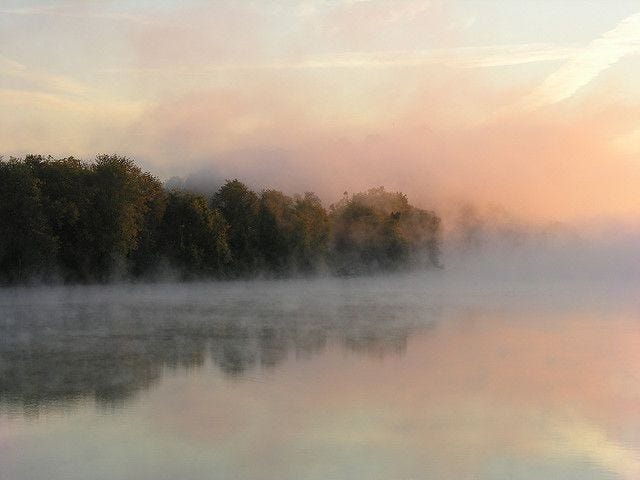
To understand this process more clearly, imagine yourself at the edge of a lake just after the sun has risen. You see your reflection, at first against the backdrop of the morning sky. Then, if you keep looking long enough, your reflection begins to disperse, and you begin to see through to the bottom of the lake underneath your reflection. Then, in time, if you can keep looking, you make your way back to the image of yourself.

Except now your reflection is a gateway to something larger than yourself. Now your sense of self is informed by the context of both the inner world and the outer world. Now your very life is revealed to you as a living conduit between worlds. And going forward, you are no longer moving as an object between things but as a living membrane of the Universe, letting things move through you. When people ask about poetry and writing, I try to explain that the life of expression is less about words and more about our fidelity to letting the things of life move through us.

The legendary composer and conductor Leonard Bernstein offered this Romantic view regarding the kinship between the soul that seeks and the ever-present Whole of Life that rushes through it:

In the beginning was the Note, and the Note was with God; and whosoever can reach for that Note, reach high, and bring it back to us on earth, to our earthly ears—he is a composer, and to the extent of his reach, partakes of the Divine.

While this notion assumes some sort of exceptionalism, that only the gifted can reach for the Divine, I am more interested in what happens when we replace the word “composer” with any form of true creative effort—whether that be by a poet, painter, sculptor, or dancer. Then, Bernstein’s vision widens to include anyone who stays in a creative conversation with life. Now, let’s replace the word “composer” with the term “authentic soul.” For at our core, when fully open-hearted and authentic, we are composed as the Universe draws the Divine out of us. This relationship with life is available to everyone. For everyone with an open heart partakes of the Divine.

There is also a Divine, anonymous giving that happens between any writer and any reader, when both are genuine and forthcoming. I’m ever touched by how a small gesture or insight can help someone a thousand miles away without our ever knowing. How something I dearly needed to learn can, in time, be read by someone in trouble. That I somehow voiced it ,and that they somehow read it, and that we both found the courage to let it be our teacher is part of the creative and introspective process. I imagine there’s someone struggling now who, in a month or so, will pick up someone else’s book and find an oar to row with. Isn’t this why we create and reflect and share what we find?

Inevitably, the stuff of life is always the stuff of art. In 1994, the legendary choreographer Bill T. Jones created a dance called Still/Here, made from the expressions and movements of the terminally ill. He showed us that every life, allowed to unfold, reveals its part in a timeless dance. Isn’t courage, then, helping each other through the next suffering into the next iteration of life’s dance? Isn’t compassion helping each other up and bearing witness to all it takes to make it through the next storm?

In truth, the more I burrow through the labyrinth of the surface world, to the deep and back into the open, the more I realize that it’s not about the words or what we produce or craft, but the rush of Divinity we inhabit—that inhabits us—when we give ourselves so completely to the call to be alive with care. Then, the Mysterious Life-Force sparks through us into the world, leaving a trail of numinous embers, which we call art. It’s happening right now as I reach toward you with love.

In truth, the things that move us—the water under that bridge slipping over the crack in that rock, or the light softening the face of someone you thought was cold, or the street musician playing the one chord that opens your heart—the things that touch us—like the sudden fox who stares into you before leaping into the forest—each mirrors a capacity that will bring us alive, if we don’t turn from the well.


Questions to Walk With
In your journal, describe a creative experience that brought you more alive by giving yourself over to it. How did creating something change you?
In conversation with someone you trust, recall a time when introspection led you to reflect beyond your own life. What connections did it reveal?
Your message resonates with me in a way it could not have resonated a week ago. I read a stunning book this past week “Theo in Golden”. As an avid reader I sometimes read very fast because I am so excited about the unfolding story. I could not do that with Theo. It was a story told with such reverence that it demanded being slow and deliberate. It demanded honoring the sacred in us.
Reading this feels like remembering how to breathe. The poem isn’t something I make, it’s what moves through when I finally stop trying to control the moment.


Your message resonates with me in a way it could not have resonated a week ago. I read a stunning book this past week “Theo in Golden”. As an avid reader I sometimes read very fast because I am so excited about the unfolding story. I could not do that with Theo. It was a story told with such reverence that it demanded being slow and deliberate. It demanded honoring the sacred in us.
Reading this feels like remembering how to breathe. The poem isn’t something I make, it’s what moves through when I finally stop trying to control the moment.